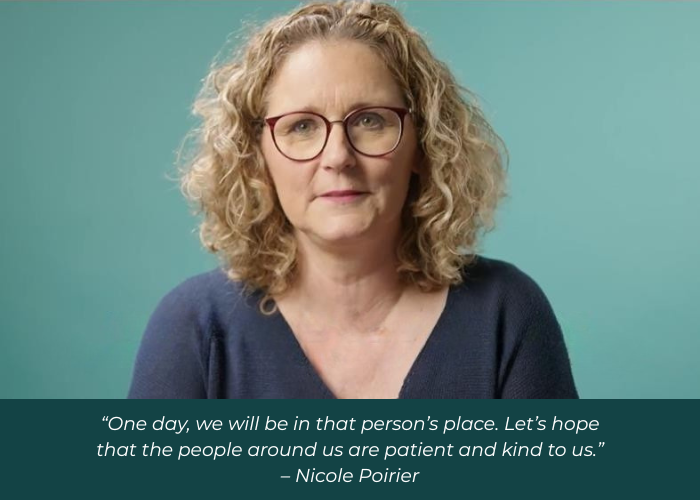
Helping someone with a neurocognitive disorder, with Carpe Diem’s Nicole Poirier and psychologist Dr. Laurence Villeneuve
Supporting someone with a neurocognitive disorder, such as Alzheimer's disease or a related disorder, is never easy. Caregivers and professionals can experience confusion, frustration, anxiety and even burnout. In this podcast, psychologist Laurence Villeneuve and Nicole Poirier, director of Maison Carpe Diem – Alzheimer Resource Centre, invite us to rethink how we view people living with a neurocognitive disorder. At the heart of their approach is one key idea: rather than focusing on what has been lost, learn to recognize and value what remains.
Our videos are only in French.
Changing our perspective on neurocognitive disorders
1. Focus on abilities rather than difficulties
In healthcare settings, there is often a tendency to focus on losses, to make a list of all the capacities that are no longer working. But this reflex can prevent us from seeing what the person still has – strengths and abilities that are still very much present. Recognizing what remains allows us to see the person beyond the diagnosis.
Practical strategies :
- Highlight small successes
- Encourage them to do what they are still capable of doing
- Build each day around successes, rather than around difficulties and shortcomings.
This approach values the person’s autonomy and helps them feel more competent.
2. Inform rather than correct
Memory loss and disorientation can place the person in a state of near-constant uncertainty. It’s understandable that waking up in a new place without knowing why would cause anxiety and confusion. What appears to be a behavioural problem is often a normal reaction to distress or to a lack of familiar reference points. Behind agitation, anger and repeated questions often lies a need for information and/or reassurance.
Practical strategies :
- Instead of correcting or pointing out the person is disoriented, calmly provide essential information, such as where they are, what they’re doing and who is with them. Sometimes these words are all it takes to ease their anxiety and restore a sense of security.
3. Focus on the person’s individuality
Receiving a diagnosis of neurocognitive disorder can be stigmatizing, both for the individual and for their loved ones. The person-centred approach focuses on what the person has always been: their life experiences, their values, their interests, and so on. As psychologist Laurence Villeneuve reminds us: “No one is ever just a disease.” Recognizing that the person has a history that goes beyond their diagnosis helps preserve their identity and sustain a relationship rooted in dignity.
Practical strategies :
- Take time to learn about the person’s life experiences and what is important to them
- Ask questions
- Listen carefully to the person to understand the needs being expressed behind their distress. If they say they want to go home, this may reflect a need for comfort or familiarity, or simply a desire to return to their room.
4. Create a welcoming environment
For many people living with a neurocognitive disorder, the desire to leave –expressed as “I want to go home” or by wandering – does not necessarily reflect a genuine wish to escape. Rather, as Carpe Diem’s Nicole Poirier points out, it may stem from feelings of disorientation, confusion or loss. When faced with this behaviour, the reflex may be to lock the doors or restrict movement. Poirier suggests a different approach: creating a welcoming and engaging environment, which can reduce the desire to leave. This can be achieved by offering simple, enjoyable daily activities, such as cooking together or going for a walk.
Practical strategies :
- Provide opportunities for movement, participation and enjoyment in a pleasant and friendly environment; this can ease anxiety and reduce oppositional behaviours
5. Preserve modesty and dignity
Personal hygiene activities can be a sensitive issue. Requests made in front of others or in a clumsy manner can deeply hurt a person with a neurocognitive disorder and lead to their refusal to cooperate. Respecting their privacy and dignity is therefore essential and can help make these difficult moments less distressing.
Practical strategies :
- Discuss hygiene-related activities discreetly (one-on-one) with the person
- Offer help respectfully when needed, rather than imposing it
- Look away when appropriate
- Demonstrating the action yourself can sometimes be more helpful than giving a long explanatio
Changing our perspective on aging
Changing how we view people living with a neurocognitive disorder also means changing how we see aging. It starts with small gestures toward our seniors: slowing down at the grocery store, sharing a meal rather than avoiding interaction, listening rather than correcting. These are simple actions that restore everyone to their rightful place as a unique individual to be seen and valued. Behind cognitive difficulties, there is still a person with an emotional life, a history and the ability to connect with others. This philosophy translates into concrete everyday actions, where every interaction becomes an opportunity to restore dignity, provide comfort and strengthen bonds with our seniors.
To learn more :
- Maison Carpe Diem – Alzheimer's Resource Centre (French only)
- Alzheimer's Society (branches in Quebec and across other provinces)
- L’Appui pour les proches aidants
- CLSCs and their support services for caregivers

Video capsules
(Our videos are only in French)